Login with Google
 Login with Facebook

In today’s beauty industry, nail salons are no longer judged only by the quality of their work or the price of a service. What truly determines growth now is how easily a salon can be discovered, trusted, and booked in a matter of seconds.
Across Texas, especially in competitive salon markets like Houston, Dallas–Fort Worth, Austin, and San Antonio, customer behavior has changed completely. People no longer choose a nail salon just by walking past it or hearing about it from friends. They discover salons through TikTok videos and Instagram Reels, then immediately move to Google Maps to verify what they see.
In cities like Houston and Dallas–Fort Worth, where competition is extremely dense, a salon can gain attention online but still lose customers if the booking process feels slow or unclear. In Austin, where customers tend to be more trend-driven and mobile-first, decisions are often made within minutes of watching short-form video content. Meanwhile in San Antonio, trust and consistency matter more, so reviews, photos, and overall digital presence play a stronger role in converting interest into real visits.
What happens next is where most nail salons unintentionally lose opportunities. A customer may discover a salon through TikTok or Reels, feel interested, and even check the Google Maps listing, but if the experience is not connected to an easy booking flow, that attention disappears quickly. This is especially common in fast-moving Texas markets where customers compare multiple salons in a short time before making a decision.
This is where VietWow focuses on a more complete approach. Instead of treating TikTok content, booking systems, payment processing, and customer management as separate tools, everything is connected into one operational system. That includes POS systems, card payment terminals, online booking, Google Maps visibility, and performance reporting that helps salon owners understand what is actually driving revenue across locations like Houston, Dallas–Fort Worth, Austin, and San Antonio.
The Shift In How Nail Salon Marketing Actually Works In Texas
In today’s beauty market, especially across Texas, the way nail salons compete has changed in a way that is no longer about visibility alone. It is about how quickly attention can be turned into a real customer action. Whether a salon is operating in Houston, Dallas–Fort Worth, Austin, or San Antonio, the pattern behind customer behavior has become surprisingly similar.
Most customers no longer start their decision with a direct search or walk-in visit. Instead, discovery happens through short-form content on TikTok and Instagram Reels. What looks like entertainment on the surface is actually the first layer of decision-making. A nail design video, a salon transformation clip, or even a simple behind-the-scenes moment is often enough to trigger interest in a local service.
In high-competition markets like Houston and Dallas–Fort Worth, this initial attention is only the beginning. Customers may watch multiple salons in a short period of time, comparing styles, cleanliness, and overall presentation before making any commitment. In Austin, where digital behavior is more fast-paced and trend-driven, decisions can happen even faster, often within a single browsing session. In San Antonio, the decision process is more trust-based, where reviews, consistency, and overall brand presence matter more than trends alone.
What connects all of these behaviors is not the platform itself, but what happens after the first impression. A customer might discover a salon on TikTok or Reels, but the next step usually takes place on Google Maps or the salon’s booking system. This is where many salons unintentionally lose potential clients, not because the marketing is weak, but because the system behind the marketing is not fully connected.
When booking feels unclear, when Google Maps information is incomplete, or when payment and POS systems do not support a smooth experience, interest quickly fades. Customers rarely wait or follow up multiple times. They simply move on to the next available option.
This is where the structure behind modern salon growth becomes more important than content alone. VietWow focuses on connecting these layers into one operational flow that supports real business activity. Instead of treating social media, booking, payments, and customer management as separate parts, everything is structured through an integrated system built around POS systems, card payment terminals, online booking, Google Maps presence, and performance tracking that reflects real customer behavior across different salon environments in Texas.
Why Most Nail Salons Get Views But Not Bookings In Today’s Digital Market
In the modern nail salon industry across the United States, especially in competitive regions like Texas, there is a growing gap between online visibility and real business results. Many salon owners notice that their TikTok and Instagram Reels content can attract thousands of views, likes, and shares, yet the actual number of booked appointments does not increase at the same pace.
This situation is not caused by a lack of marketing effort. In fact, many nail salons in cities such as Houston, Dallas–Fort Worth, Austin, and San Antonio are actively posting content every day. The real issue is that attention is not being converted into action in a structured way that supports how customers actually make decisions.
Most potential clients move through a very specific decision path. They first discover a nail design or salon video on social media. That moment creates interest, but not commitment. After that, they usually try to validate the salon through Google Maps, reviews, or online presence before making any booking decision. If any part of this path feels incomplete or unclear, the customer simply moves on.
This is where many salons lose opportunities without realizing it. A strong social media presence may bring attention, but if booking information is hard to find, if the Google Maps profile does not feel active, or if the payment and POS experience does not support a smooth transaction, the interest never turns into revenue.
The problem is not isolated to marketing or operations alone. It is a system disconnect. Social media, Google Maps visibility, online booking tools, and POS systems are often running separately without a shared structure that connects customer behavior from discovery to payment and return visits.
VietWow addresses this issue by focusing on the operational side of salon growth. Instead of treating TikTok content, booking systems, payment processing, and customer management as separate tools, they are designed to function as one connected system. This includes POS systems, card payment terminals, online booking integration, Google Maps presence management, and performance tracking that reflects how customers actually move through the decision process.
Why Google Maps Has Become A Critical Decision Point For Nail Salons
Even when customers discover a nail salon through TikTok or Instagram Reels, the majority of them still rely on Google Maps before making a final booking decision. At this stage, Google Maps is no longer just a navigation tool. It functions as a trust filter.
Customers naturally evaluate several factors before choosing a salon. They look at the consistency of reviews, the quality and freshness of photos, the clarity of services, business hours, and how easy it is to take the next step such as calling or booking online. In many cases, this single step determines whether a potential customer becomes an actual appointment or disappears into another option.
This behavior is especially visible in competitive Texas markets where customers have multiple nearby options. In places like Houston and Dallas–Fort Worth, customers often compare several salons within minutes. In Austin, decisions are faster and more trend-driven, while in San Antonio, long-term trust and consistency play a stronger role in conversion.
What many salon owners overlook is that Google Maps performance is not only about ranking. It is about perceived reliability. A salon with active updates, strong visuals, and clear booking access feels more trustworthy than one that appears inactive, even if both offer similar service quality.
Google evaluates local businesses based on relevance, distance, and prominence, but real customer behavior adds another layer. Engagement signals such as reviews, photo updates, and customer interactions often influence how confidently a customer decides to book. When these signals are weak or outdated, even strong social media marketing can fail to convert interest into real appointments.
How Online Booking And Integrated POS Systems Reshape Nail Salon Conversions
In today’s nail salon industry, especially across competitive U.S. markets like Texas, customer expectations have shifted far beyond simple service availability. People no longer accept delays in communication or fragmented booking experiences. They expect a direct, seamless path from discovery to appointment confirmation without friction.
Whether a customer first discovers a salon through TikTok, Instagram Reels, or a local search on Google Maps, the next step is almost always the same. They want to check availability instantly, understand services clearly, and secure an appointment without needing to call or wait for a reply. This expectation has become standard in fast-moving salon environments across cities such as Houston, Dallas–Fort Worth, Austin, and San Antonio.
When an online booking system is properly structured, it does more than just show available time slots. It becomes part of the customer decision process. It allows clients to compare services, choose technicians, confirm appointments in real time, and receive automated reminders that reduce no-shows. In practice, this directly impacts how many leads from social media actually turn into paying customers.
The difference between a high-performing salon and an average one is rarely about how many people see the content. It is about how quickly that attention can be converted into a confirmed booking. When booking systems are disconnected from the rest of the business, even strong marketing campaigns struggle to produce consistent results.
This is why VietWow integrates online booking directly into a broader operational structure that includes POS systems, payment processing, and customer management. Instead of treating booking as a standalone feature, it is designed as part of a complete flow that connects customer discovery, appointment scheduling, in-store experience, and post-visit retention.
Why POS Systems Have Become The Core Infrastructure Of Modern Nail Salons
A POS system in today’s nail salon environment is no longer just a checkout tool. It functions as the operational foundation that connects every part of the business, from daily transactions to long-term customer behavior analysis.
In real salon operations, especially in busy markets like Houston or Dallas–Fort Worth, speed and accuracy at checkout directly affect customer experience. A slow or confusing payment process can interrupt service flow, reduce perceived professionalism, and even impact repeat visits. This is why modern POS systems must be designed for both simplicity at the front desk and depth in the background.
A properly built nail salon POS system should support more than transactions. It should track customer history, service patterns, technician performance, and revenue distribution across different services. It should also integrate naturally with online booking systems so that appointments, walk-ins, and repeat customers are all recorded in a single structured environment.
When POS data is isolated, salon owners often rely on assumptions to make decisions about staffing, promotions, or pricing. But when POS systems are connected with booking data and customer activity, the business gains a clearer view of what is actually driving revenue and retention.
In practice, this means a salon can understand not only how many customers visited, but also which services are growing, which time slots are most valuable, and which customer groups are most likely to return. In competitive environments like Austin or San Antonio, this level of insight can significantly improve operational decisions without adding complexity to daily work.
VietWow builds POS systems with this operational reality in mind. The focus is not on adding unnecessary complexity, but on creating a system that supports fast service, accurate reporting, and a clear connection between marketing activity and real business outcomes.
How AI Reporting And Connected Systems Change The Way Nail Salon Owners Make Decisions
In today’s nail salon industry, especially across competitive U.S. markets like Texas, business decisions are no longer based on intuition alone. Owners in cities such as Houston, Dallas–Fort Worth, Austin, and San Antonio are operating in an environment where customer behavior changes quickly, marketing platforms move fast, and competition is highly visible across both social media and local search.
In this environment, relying on spreadsheets or delayed monthly summaries is no longer practical. Many salon owners find that by the time they review performance data, the opportunity to adjust pricing, staffing, or promotions has already passed. This delay creates a gap between what is happening in the salon and what the owner actually understands about the business.
AI-powered reporting changes this dynamic by bringing clarity closer to real-time operations. Instead of manually compiling numbers, salon owners can see patterns in customer behavior, service performance, and revenue flow in a way that is easier to interpret and act on. More importantly, these insights are not isolated data points. They are connected to actual salon activity through POS systems, booking systems, and payment records.
In practical terms, AI reporting helps salon owners understand how their business is actually performing beyond surface-level sales. It becomes possible to see which services consistently generate strong revenue, which time periods drive the highest demand, and how staff performance varies across different service categories. In busy salon environments like Houston or Dallas–Fort Worth, this level of visibility can directly influence scheduling decisions and operational efficiency.
It also helps connect marketing performance with real customer behavior. For example, when traffic comes from TikTok or Instagram Reels, AI reporting combined with POS data can help identify whether that attention actually turns into booked appointments and completed services. This is especially important in markets like Austin, where digital engagement is high, but conversion depends heavily on speed and convenience in the booking and checkout experience.
When AI reporting is integrated with POS systems and online booking tools, it becomes part of a larger operational structure rather than just a reporting feature. This structure allows salon owners to move from reactive decision-making to more informed planning based on actual customer patterns. Instead of guessing what is working, they can see how each part of the business contributes to overall performance.
How Connected Systems Turn Marketing And Operations Into One Continuous Flow
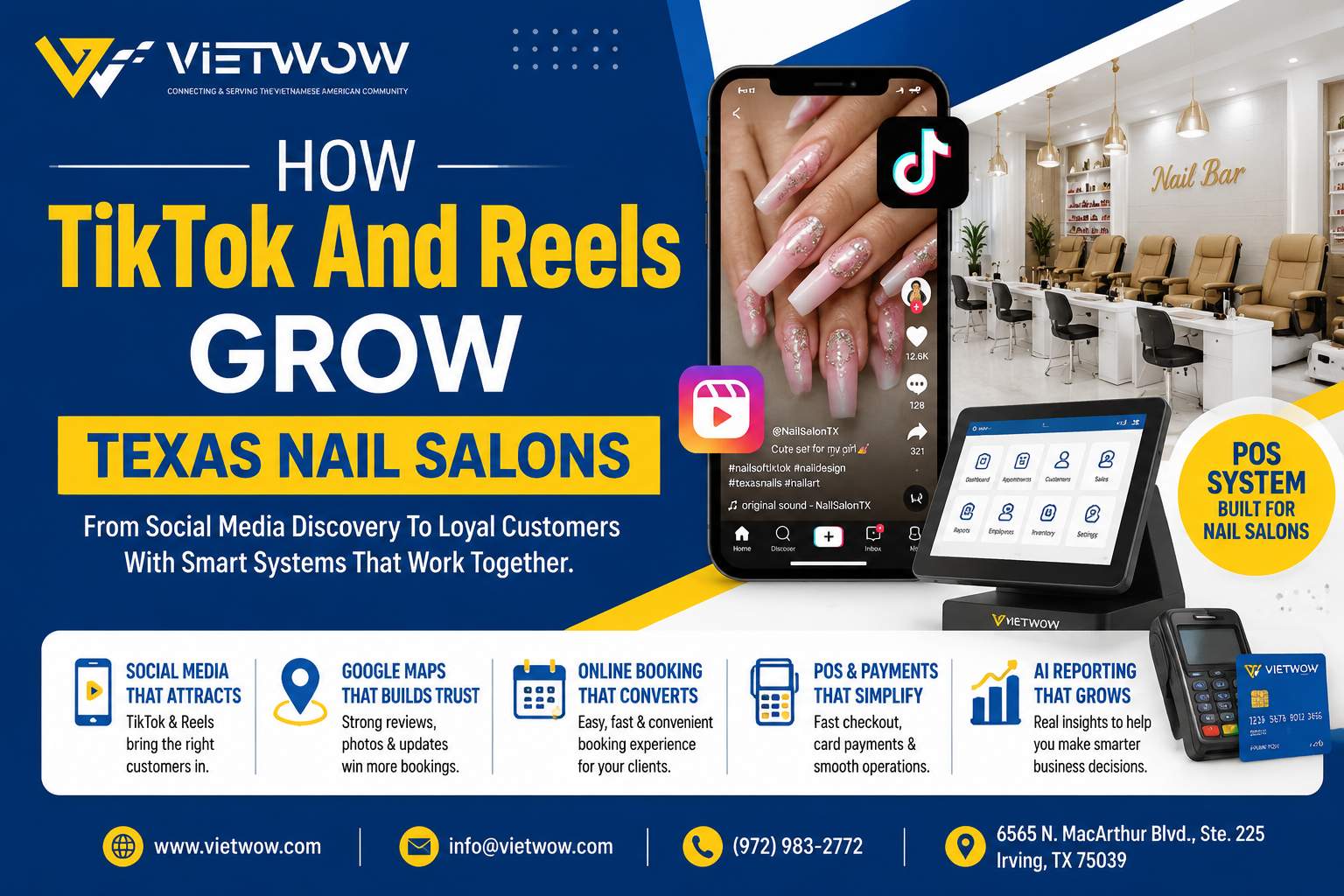
The real shift in modern nail salon growth is not coming from a single tool, but from how different systems work together. TikTok and Instagram Reels create initial attention. Google Maps builds trust at the local level. Online booking turns interest into appointments. POS systems manage transactions and customer records. AI reporting turns that data into actionable insight.
When these systems operate independently, each one provides limited value on its own. Marketing may generate views without conversions. Booking systems may handle appointments without understanding where customers come from. POS systems may record transactions without connecting them back to marketing performance. This separation creates inefficiency in decision-making and limits long-term growth potential.
When these systems are connected, the customer journey becomes clearer and more predictable. A customer might discover a nail design through TikTok or Reels, verify the salon through Google Maps, book an appointment instantly online, complete the service in-store, and generate structured data through the POS system. That data then feeds into AI reporting, which helps the owner understand what is working and what needs improvement.
This creates a continuous feedback loop where marketing, operations, and customer experience are no longer separate functions. Instead, they reinforce each other through real data. In competitive markets across Texas, including Houston, Dallas–Fort Worth, Austin, and San Antonio, this level of integration helps salons stay consistent even when customer demand and trends shift quickly.
VietWow focuses on building this type of connected system for nail salons. Rather than treating AI reporting, POS systems, card payment terminals, online booking, and marketing tools as separate services, the goal is to unify them into one operational flow that reflects how real salon businesses operate and grow over time.
How Nail Salon Growth Actually Works Across Competitive Texas Markets
In highly competitive beauty markets across the United States, and especially in Texas, nail salon growth is no longer determined by location alone. It is shaped by how well a business connects customer discovery, booking behavior, in-store experience, and long-term retention into one continuous system.
In Houston, where demand is consistently high and walk-in traffic remains strong, salons often depend on speed, staff coordination, and the ability to handle high-volume customer flow without losing service quality. Growth in this environment is not just about attracting customers, but about managing capacity efficiently so that no opportunity is lost during peak hours.
Successful salons in Houston tend to operate with a clear balance between walk-in management, digital visibility, and operational control. Social media presence brings attention, but it is the booking system and POS infrastructure that determine whether that attention becomes completed appointments and repeat visits.
In Dallas–Fort Worth, the dynamic is different. The market is spread across multiple suburban areas, each with its own customer behavior and spending pattern. Some areas prioritize premium services and brand presentation, while others focus more on convenience and accessibility. This makes scalability an important factor. A salon that can maintain consistent service quality, track customer history, and manage operations across different demand zones gains a clear advantage.
For Austin, customer behavior is heavily influenced by digital discovery and trend-based decision making. Clients often engage with short-form content before visiting a salon, and they expect fast transitions from interest to booking. In this type of environment, any delay in the booking process or lack of clear online presence can directly reduce conversion rates, even if the salon has strong creative work.
San Antonio follows a slightly different pattern where trust, consistency, and long-term customer relationships play a stronger role. Here, reputation built through reviews, service consistency, and repeat customer experience often matters more than rapid trend exposure. However, even in this market, digital systems still determine how easily a customer moves from discovery to appointment confirmation.
Across all of these Texas markets, one pattern remains consistent. Growth does not come from a single channel. It comes from how well a nail salon connects its marketing, booking flow, payment process, and customer management into a unified system.
Why Operational Systems Matter More Than Individual Marketing Channels
Many nail salons today can generate attention through TikTok, Instagram Reels, or local search visibility. However, attention alone does not guarantee business growth. The difference between a busy social media profile and a profitable salon often lies in what happens after the customer shows interest.
When booking systems are disconnected, when POS data is not linked to customer behavior, or when payment processes slow down the in-store experience, the overall system loses efficiency. Customers expect seamless interaction from discovery to checkout, and any friction in that process increases the chance of losing a booking.
This is why modern salon operations rely heavily on integrated systems that combine online booking, POS functionality, card payment processing, and customer data tracking. When these elements work together, the salon is able to understand not only how many customers are coming in, but also how those customers are acquired and how often they return.
VietWow focuses on building this type of operational structure for nail salons by connecting marketing channels, booking systems, POS platforms, and payment infrastructure into one unified environment that reflects real customer behavior rather than isolated data points.
How Trust, Consistency, And Operational Systems Shape Nail Salon Growth In San Antonio
In the San Antonio nail salon market, growth is less about rapid trends and more about long-term stability. Customers in this environment tend to value trust, consistency, and familiarity over aggressive promotions or short-term marketing spikes. They return to the same salon when the experience feels reliable, predictable, and professionally managed over time.
This behavior creates a different type of competitive structure compared to faster-moving markets like Houston or Austin. Instead of constant customer turnover driven by trends, San Antonio salons often rely on repeat visits, referrals, and sustained service quality. In this context, every customer interaction becomes part of a long-term relationship rather than a one-time transaction.
However, even in a trust-driven market, operational systems still determine how effectively that trust is converted into revenue. A salon may have strong customer loyalty, but if booking is unclear, if payment processes feel slow, or if customer history is not properly tracked through a POS system, the overall experience becomes fragmented.

Why Operational Systems Matter More Than Marketing Alone
Across Texas markets, including San Antonio, Houston, Dallas–Fort Worth, and Austin, many nail salons face the same structural challenge. Marketing can generate attention, but operations determine whether that attention turns into actual appointments and repeat customers.
A salon may build visibility through social media or local search, but the customer journey does not end at discovery. It continues through booking, in-store service, payment processing, and post-visit engagement. When any part of this flow is disconnected, the experience feels inconsistent, and long-term retention becomes harder to maintain.
This is why modern salon growth depends heavily on connected systems rather than isolated tools. Online booking, POS systems, card payment processing, and customer management must work together as one operational structure. When these systems are integrated, salon owners gain a clearer understanding of customer behavior, service demand, and revenue patterns.
In practical terms, this means knowing not only who booked an appointment, but also how they discovered the salon, what services they prefer, how often they return, and how much value they generate over time. This level of clarity is essential for building a stable and scalable salon business in competitive environments across Texas.
VietWow focuses on this operational alignment by connecting POS systems, payment terminals, booking systems, and marketing activity into one unified structure designed around real salon workflows rather than disconnected software functions.
Why Long-Term Salon Growth Depends On Connected Customer Experience
In modern nail salon operations, growth is no longer driven by a single channel or tool. Instead, it comes from how well each part of the customer experience connects together from the first moment of discovery to the final payment and beyond.
Social media may introduce a customer to a salon, but it is the booking system that determines whether that interest becomes a confirmed appointment. Google Maps provides trust validation, but it is the POS system that records actual transactions and customer history. AI reporting then helps translate that operational data into insights that support better decisions over time.
When these systems are disconnected, salons often experience inconsistent performance. When they are connected, the entire business becomes more predictable, more measurable, and easier to scale without losing service quality.
Across Texas, including Houston, Dallas–Fort Worth, Austin, and San Antonio, this integrated approach is becoming increasingly important as customer expectations continue to rise. Clients expect faster booking, smoother checkout experiences, and more reliable service consistency across every visit.
VietWow’s approach is built around this reality, focusing on combining POS systems, card payment processing, online booking, and marketing visibility into one continuous operational flow that supports both customer experience and business performance.
Contact VietWow
- Website: www.vietwow.com
- Email: info@vietwow.com
- Nationwide Hotline: (972) 983-2772
- Head Office: 6565 N. MacArthur Blvd., Ste. 225, Irving, TX, 75039